
Failing Better: A Field Trainer’s Guide to Failure, Growth Mindset, and Resilience in EMS
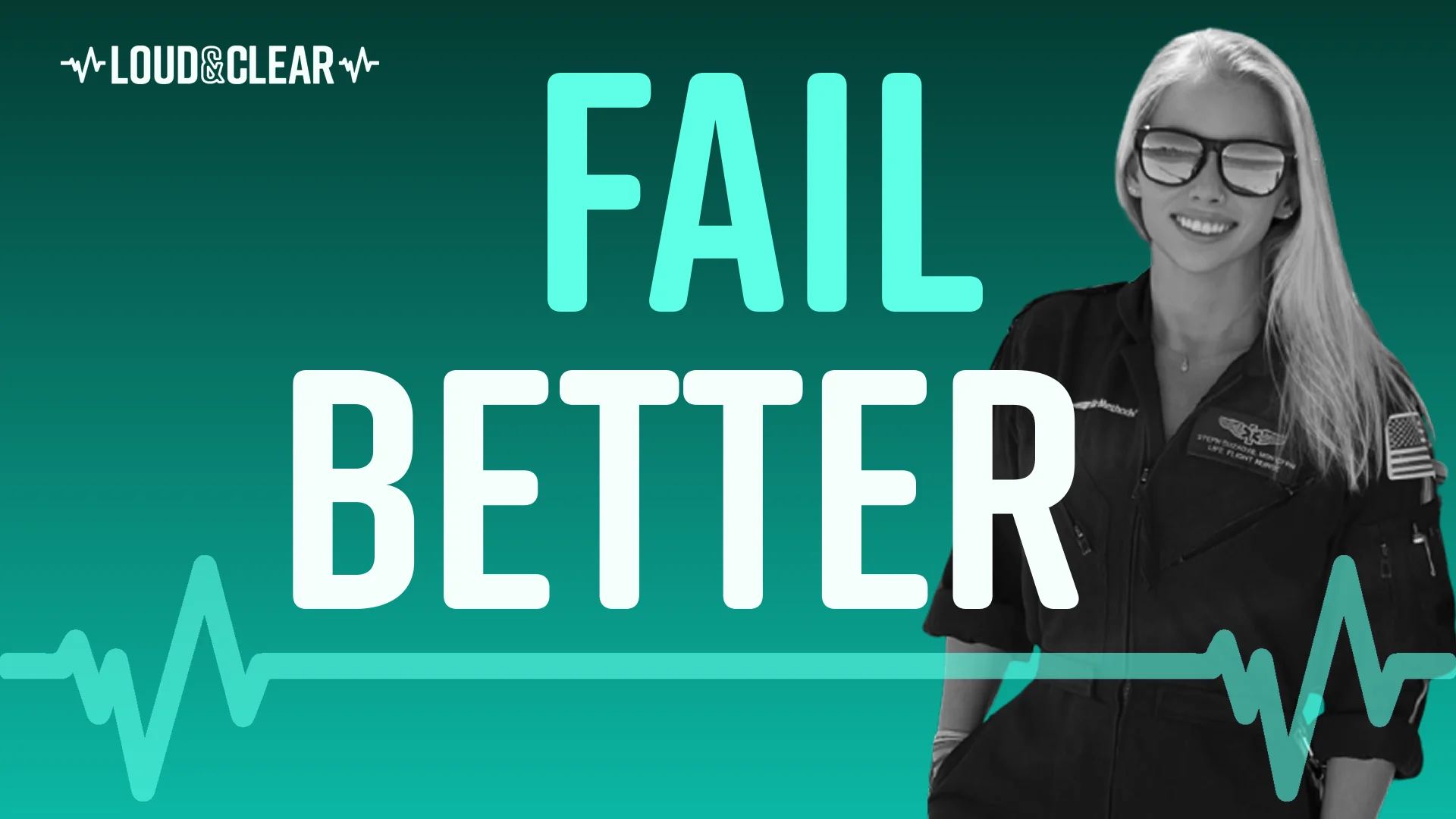
Adapted from Loud & Clear Episode: How to Fail Better in EMS: A Framework for Growth — with flight nurse Stephanie Suzadail.
Every field trainer hits the same wall. A new medic makes a mistake, shrinks, and retreats into “I’m bad at this” or “I’m not cut out for this.” What mattes is what they do next. This post maps the working framework flight nurse Stephanie Suzadail laid out in our interview — a model of failure, growth mindset, and resilience you can use on your next ride-along, post-shift debrief, or coaching conversation.
1. The Sisyphus Problem — Failure Without Reflection
Sisyphus rolled a boulder up a hill for eternity, then watched it roll back down. Stephanie uses this as the metaphor for failures that don’t teach: the same error, the same consequence, the same outcome, over and over. Einstein’s definition of insanity applied to clinical practice.
Field application: when a learner repeats the same mistake, the issue is rarely the mistake itself. It’s that no one paused long enough to ask what happened and why. Before you let a medic move on, force the pause. The boulder goes somewhere different only when something changes before it rolls back down.
2. A Growth Mindset Is the Precondition for Resilience
A growth mindset prepares you to be resilient. It is not necessarily the resilience itself but it is the soil resilience grows in.
In EMS terms: the medic who says “I did X wrong, I need to learn Y” will bounce back from a bad call. The medic who says “I’m just not good at airways” will not. Same mistake, two different outcomes, driven entirely by the internal frame. Coach for the frame first. Only then can the skills follow.
How to coach the frame
- Replace “You’re not good at X” with “You have not yet built reps at X.”
- Name the difference between skill gap (trainable) and identity claim (fixed).
- Make the medic say out loud what specifically they’ll do differently next time.
3. Just Culture and the 10x Reporting Rate
High-functioning organizations report mistakes ten times more often than average ones.
The counterintuitive lesson here is that more reported errors is a sign of a healthier system, not a worse one. When reporting is safe, errors surface and steps are taken to prevent future errors. When it isn’t, errors get hidden, repeated, and systematized.
As a trainer, your first reaction to a learner’s mistake is the single biggest factor in whether they bring you the next one. If you punish the first, you will never see the second. Build the culture where someone wants to tell you what went wrong in order to seek your help in improving.
4. “Who Would You Rather Be Treated By?”
The clinician who’s never made a mistake, or the one who’s made many? Stephanie’s answer? The one who’s made many because they know what being wrong feels like, they have identified why it happened, and they have built the internal systems to prevent it next time.
A clinician who has never made a mistake likely either (a) has not practiced enough to encounter one, or (b) has made them and hidden them. Neither profile is the one you want on your worst day. Scars are information. Absence of scars is either inexperience or concealment.
5. The Imperfectionist Advantage
Research has shown that self-identified perfectionists are only moderately successful in studies of high performers. The highest performers are what I like to refer to as “effectively imperfect” — You don’t have to be perfect, you just have to be good enough.
We should coach the learner toward specificity, not self-flagellation. “What three things went right and what one thing would you change next time?” is better and more effective than “What did you do wrong?” .
Perfectionism sounds like standards. It usually functions as avoidance.
6. There Is No Timeline
Stephanie’s shared some vulnerability talking about her own past failures. She passed four of forty-eight credits her freshman year of college during a severe mental health crisis, including a failed suicide attempt. She finished her bachelor’s in six years instead of four. She went on to become a very effective flight nurse.
The lesson she teaches now: there is no timeline. Not for school, not for certifications, not for being “ready.” The fifty-year-old starting nursing school is as valid as the twenty-two-year-old. The medic getting their first save in year three of street time is as valid as the one who got it in month four.
When a learner is measuring themselves against another learner’s pace, redirect. The only relevant question is: “Are you moving forward from where YOU were last month?”
Key Takeaways
- Failure without reflection is Sisyphus. Force a pause before we move on from the failure.
- A growth mindset is the soil resilience grows in. Coach for the frame first; skills follow.
- Reported errors are a system-health signal, not a failure signal. Make reporting safe.
- The clinician you want on your worst day has made mistakes — and owned and learned from every one.
- Effective imperfection beats perfectionism. Coach specificity, not shame.
- There is no timeline. Measure learners against their own last month, not a peer’s.