You walk to a door. Your mind’s on the shopping list, the fight you had this morning, the call you just cleared. You push. Nothing happens. You look up. It says PULL.
That’s not stupidity. That’s what happens when outside factors override your intelligence.
And it’s exactly what’s happening on your critical calls.
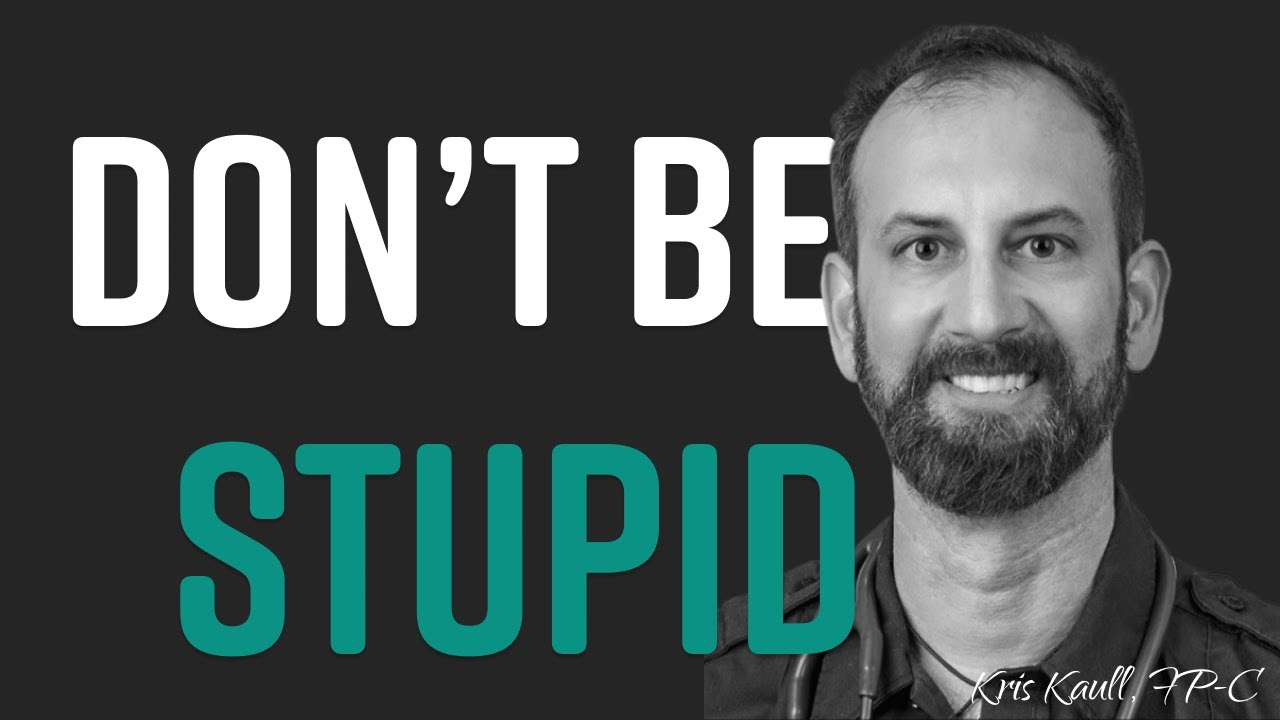
Kris Kaull—flight paramedic and EMS leader—breaks down why experienced providers make preventable mistakes and the mathematical framework that contributes to them. When you understand the risk factors, you can do something about them.
This isn’t about being smarter. It’s about controlling the seven variables that determine whether you catch errors or make them.
The Seven Risk Factors That Make You Stupid
Adam Robinson and Shane Parrish distilled all human error down to seven factors. Not personality flaws. Not intelligence gaps. Seven situational variables that increase mistake probability:
1. Being rushed
2. Information overload
3. Operating outside your normal environment
4. Working in a group
5. Being an expert or in the presence of one
6. Requiring intense focus
7. Physical and emotional fatigue
It’s math. When seven out of seven risk factors present? You’re likely to make mistakes. Two out of seven? Your probability drops.
Risk Factor #1: Being Rushed (Even When You Think You Need To Be)
The R in RSI stands for rapid. But that’s not the goal state.
The goal is: secure the airway, support ventilation, do no harm.
Studies prove that crews using checklists get tubes in faster—not slower—than those rushing through the procedure from memory. The systematic approach beats speed because you’re not backtracking, forgetting equipment, or missing critical steps.
Aviation proved this decades ago. A pilot with 10,000 hours on the same aircraft type still walks actively through the checklist. Not reading it passively but reading it, looking, confirming, moving to the next item.
The Action Step:
Before RSI, ask: “Are we prioritizing rapid, or are we prioritizing no harm?” Then run your checklist. Time yourself if you don’t believe it—systematic is faster.
Equipment verified. Team roles assigned. Plan A through Plan C stated aloud with back up devices within arms reach. Now you can focus on the actual medicine instead of remembering whether you grabbed the bougie.
Risk Factor #2: Information Overload
You have drug dosages, contraindications, equipment locations, team communication, scene safety, patient history, and transport decisions competing for the same mental bandwidth.
That’s cognitive overload.
Offload everything standardizable so your mind can focus on what requires actual clinical judgment.
Again, pilots don’t memorize pre-flight procedures every time they fly. They use checklists so their brains can focus on weather conditions, air traffic, and the thousand variables that require real-time decision-making.
You should do the same. Cheat sheets for drug dosages. Checklists for equipment setup. Standardized structures for handoff reports.
The Action Step:
Build your Cognitive Offload System: create laminated checklists specific to your system and make them easily accessible.
When your brain isn’t cluttered remembering what milligram dose comes in what milliliter vial, you can see the whole patient.
Risk Factor #3: Odd Environments (Control What You Can)
By definition, EMS operates in environments that are never normal. Hoarder houses. Highway medians. Basements with poor lighting. Apartment bedrooms with one narrow stairway in and out.
You can’t control that.
But you can control your response to it.
Kaull has a pre-game ritual that helps with his sense of control and prepares him mentally for shifts. Before checking out the helicopter or starting shift, he lays out his equipment. Every item in the same spot. Flight suit organized identically. A routine that creates familiarity in chaos.
Fire departments standardized this years ago: same approach to traffic control at crashes, same battery disconnect protocols, same extrication sequence. The car type might change, the location might change—but the system doesn’t.
Control the way you set your equipment up, the same way, every time, for every procedure.
The Action Step:
Create you Environmental Control Protocol:
– Pre-shift: set up your personal equipment in the same configuration every time
– Advocate for standardized ambulance setups across your service
– Develop a mental pre-scene checklist: “Here’s what I’m walking into, here’s what I control”
When your gear is always in the same pocket and your monitor is always in the same bag position, your hands know where to go even when your mind is processing the weird scene in front of you.
Risk Factor #4: Group Dynamics (The Quiet Person Sees What You Don’t)
Different personalities create a third dynamic when working together. The boisterous person dominates. The meek person stays silent. The studious person observes but doesn’t speak up.
And often, the person not speaking is the one who sees the mistake coming.
Kaull combines this with risk factor #5—expert presence. When someone has perceived higher education or more experience, you give away your voice. “They probably know more than me” becomes the reason you don’t double-check, don’t question, don’t speak up.
That’s where errors happen.
The aviation solution: Inquire, Advocate, Assert.
– Inquire first: “Hey, what do you think about this alternative approach?”
– Advocate if needed: “I really think we should consider this alternative because…”
– Assert if it’s unsafe: “No, this is unsafe. We need to stop and do X.”
The Action Step:
Train your crew on The Voice Escalation System. Make it a cultural standard that questioning isn’t disrespect—it’s safety. The newest person on scene has permission to inquire. The BLS provider has permission to advocate to the paramedic. Anyone has permission to assert if something’s truly dangerous.
Tell your crew at the beginning of the shift: “It’s not a mistake until we all make it. I intend to do things by the books, if you see me doing something outside of protocol it’s probably unintentional and you should speak up.”
Practice it in simulation. Role-play the uncomfortable moment of speaking up to the doctor on scene. Build the muscle memory so it happens when it matters.
Risk Factor #6: Intense Focus (Tunnel Vision Needs Backup)
Kaull ran a high-fidelity simulation: downed wildland firefighter, soot in mouth, breathing poorly, traumatic injuries. The ALS provider was task-saturated—setting up for intubation, organizing equipment, mentally running through the procedure.
The BLS partner asked twice: “Is this the right medication? Is this the right dose?”
The ALS provider didn’t hear her. Not because they were ignoring her. Because tunnel vision had taken over.
Tunnel vision isn’t bad. It’s what allows you to perform complex procedures at a high level. But tunnel vision without someone else seeing the whole picture? That’s where you fall into trouble.
The Action Step:
Build The Situational Awareness Backup System:
– On complex calls, assign one person as the “big picture” observer
– If you’re tunnel-visioned on a procedure, empower your partner to verify everything else
– Create the cultural norm: “If I’m focused on intubation, you own the bigger picture, I need you to continue to coordinate and delegate the team and tell me if something is going wrong and I need to stop and shift focus”.
Risk Factor #7: Fatigue (You’re Operating at 15% Thinking It’s 100%)
Kaull is a high-achieving pleaser. He says yes to everything. Good opportunities, helping colleagues, picking up shifts.
And his mentor told him: “Stop saying yes to all the good things in life so you have bandwidth for the great.”
When you’re fatigued—physically or emotionally—you’re not giving 100%. You’re giving maybe 10% or 15% and thinking it’s full effort.
The new mom example: She’s up every two hours feeding the baby. She’s exhausted but refuses help because “the baby needs me.” If someone watched the baby for four hours and she slept, how much more responsive would she be to the infant’s needs when she’s awake?
You’re doing the same thing. Working your fourth 24-hour shift. Picking up overtime because the service is short. Giving back to others while operating on empty.
The Action Step:
Implement The Bandwidth Protection System:
– Practice saying no: “I can’t take that shift because I need to show up excellently for my family and for the patients on my next shift”
– Reframe selfishness: Showing up depleted serves no one
If you’re at 15% capacity, you’re hitting all seven risk factors harder. You rush because you’re tired. You miss information because you’re foggy. You don’t speak up because you’re exhausted. Fatigue multiplies every other risk factor.
Build a System That Makes Stupidity Mathematically Unlikely
You’re not stupid. You’re operating in an environment designed to create mistakes.
The PULL door moment happens because outside factors override your intelligence. The same thing happens on critical calls when you’re rushed, overloaded, in odd environments, managing group dynamics, dealing with experts, task-saturated, and fatigued.
The solution isn’t working harder. It’s controlling the variables.
Create your pre-game ritual. Build your checklists. Standardize your equipment setup. Train your crew on voice escalation. Assign big-picture observers. Protect your bandwidth.
When you drop from seven risk factors to one or two, your mistake probability decreases.
Start with one: Pick the risk factor hitting you hardest right now. Build one system to control it. Then move to the next.
The goal isn’t perfection. The goal is reducing the mathematical probability that you’ll push when it says PULL—on doors, on calls, on decisions that matter.
Understand the seven-factors. Stop being stupid not because you’re smarter, but because you’ve eliminated the conditions that make smart people make dumb mistakes.
Your patients deserve you at full capacity. Build the system that delivers it.