
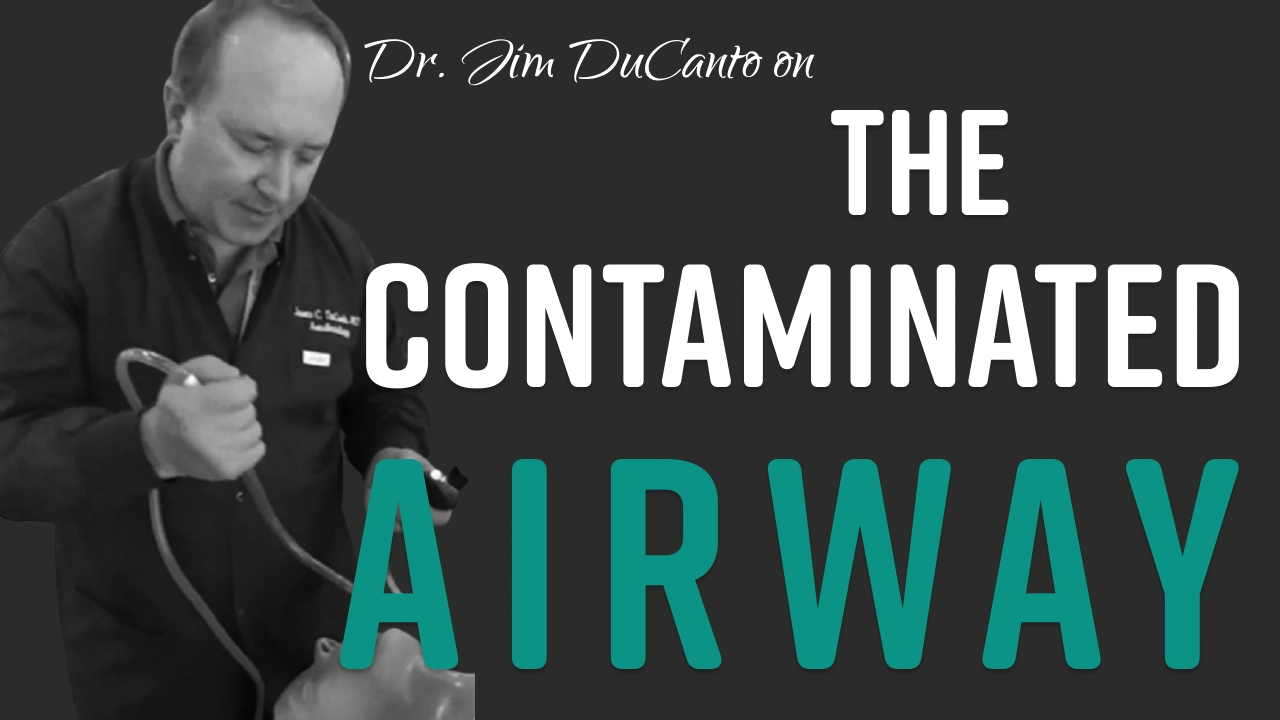
Suction First: Dr. Ducanto on the Contaminated Airway and What Comes Next — Supplemental Blog Post
The Contaminated Airway Has a Solution. Here’s What Every Paramedic Needs to Know About SALAD.
There’s a moment that happens in the back of an ambulance that everybody dreads.
Your patient is bleeding into their airway. Or vomiting. Or both. You put your laryngoscope in and you can’t see anything. Your suction catheter — if you have it, if it’s set up, if it’s anywhere near you — is a thin plastic tube that moves fluid about as fast as a garden straw.
You were trained to intubate in a clean OR on an elective surgical patient. You are now in the back of a moving truck with a contaminated field and fifteen seconds to make a decision.
Dr. Jim DuCanto saw this gap and decided it was unacceptable.
He invented the DuCanto catheter and pioneered the SALAD technique — Suction Assisted Laryngoscopy and Airway Decontamination.
What is SALAD?
SALAD is a technique, not a product. The core idea: use a large-bore rigid suction catheter proactively, not reactively, to decontaminate the airway ahead of your laryngoscope.
The sequence:
- Optimize positioning and pre-oxygenation before you start.
- Place the rigid suction catheter midline, around the base of the tongue. Suction left and right.
- Hold the catheter in your right hand like an upside-down laryngoscope, tip facing away from you, down and away. Push the tongue to the floor of the mouth and lift. One motion opens the oropharynx and hypopharynx.
- Place your laryngoscope over the base of the tongue, carefully, without dragging contaminants over your light or video source.
- Lead your laryngoscope blade with your suction, suctioning contaminants before they have an opportunity to reach your blade.
- Once you have a view of the cords, adjust the suction catheter, to move it out of the way for tube delivery. Take it out, put it back in on the left side of the blade, to maintain suction in the field while you work. Before you deliver the tube, confirm you have space.
- After the tube is in: suction the ET tube before you ventilate.
No special equipment required to practice the hand mechanics. Any airway mannequin on your unit works. The muscle memory is the point.
The Downside Nobody Talks About
Dr. DuCanto is unusually candid about the limitations of his own technique.
Three things to know:
First: Continuous suction can trap uvular or pharyngeal mucosa. Be deliberate about catheter placement.
Second: If you’re running apneic oxygenation (15 LPM or greater nasal oxygen), continuous suction is pulling your supplemental O2 out of the field. In a prolonged attempt, this may matter.
Third: The catheter doesn’t exist if you can’t carry it. Portability is a clinical requirement. If your suction setup is too big to bring in on that cardiac arrest, it doesn’t exist when you need it.
Why Video Laryngoscopy Should Be the Default. Always.
Paramedic students doing OR rotations should intubate with video laryngoscopy. Not direct. Video.
They’ll always see what they’re doing. They’ll always get the tube. There’s minimal risk to the elective patient. And if they’re not creating problems for the anesthesiologist, the anesthesiologist will keep letting them come back.
The argument against this — that paramedics won’t always have video laryngoscopy in the field — is outdated. Video laryngoscopy is becoming standard. Medical directors are reviewing footage. The field of airway management is moving whether or not training has caught up.
Stop training on what we used to have. Train on what we’re going to require.
The Part That Actually Matters
Dr. DuCanto told Will about an experienced paramedic from suburban Chicago who stepped up to the SALAD simulator, took a few deep breaths, and then held his breath before he started.
What Ducanto saw wasn’t just focus. It was fear. It was anguish. And what happened over the next four or five repetitions was something beyond skill acquisition. It was a paramedic rewriting history in his own head. Replaying calls he couldn’t get right. Seeing what he could have done differently.
That’s what deliberate practice does at its best. It doesn’t just build skill. It heals and builds confidence.
Dr. Jim Ducanto joined Will Berry on Loud & Clear, recorded at the FASTCAN conference. Listen to the full episode for an even more in depth discussion.
If this is the kind of thinking you want more of, sign up for The Confidence Dispatch — our free weekly newsletter. Subscribe here –
https://loudandclear.kit.com/d45b012fae
And if you’re ready for real coaching and mentorship, the Paramedic Confidence Builder Fellowship is built for paramedics who don’t coast, book a short free discovery call to learn if the program is a good fit for you –
https://calendly.com/d/cq38-87r-fkk/paramedic-confidence-builder